June 9, 2026
A River Runs Through It
A River Runs Through It
By Tucker Mitchell | Spring / Summer 2026 | FMU Focus Magazine Spring / Summer 2026
When Francis Marion University (then, College) opened in 1970, folks marveled at the vastness and natural beauty of the campus, located on donated (and later, some additional, purchased) acreage just east of Florence.
Just look at all this land, they said.
Yes, that is nice … but boy oh boy, if they could see it now.
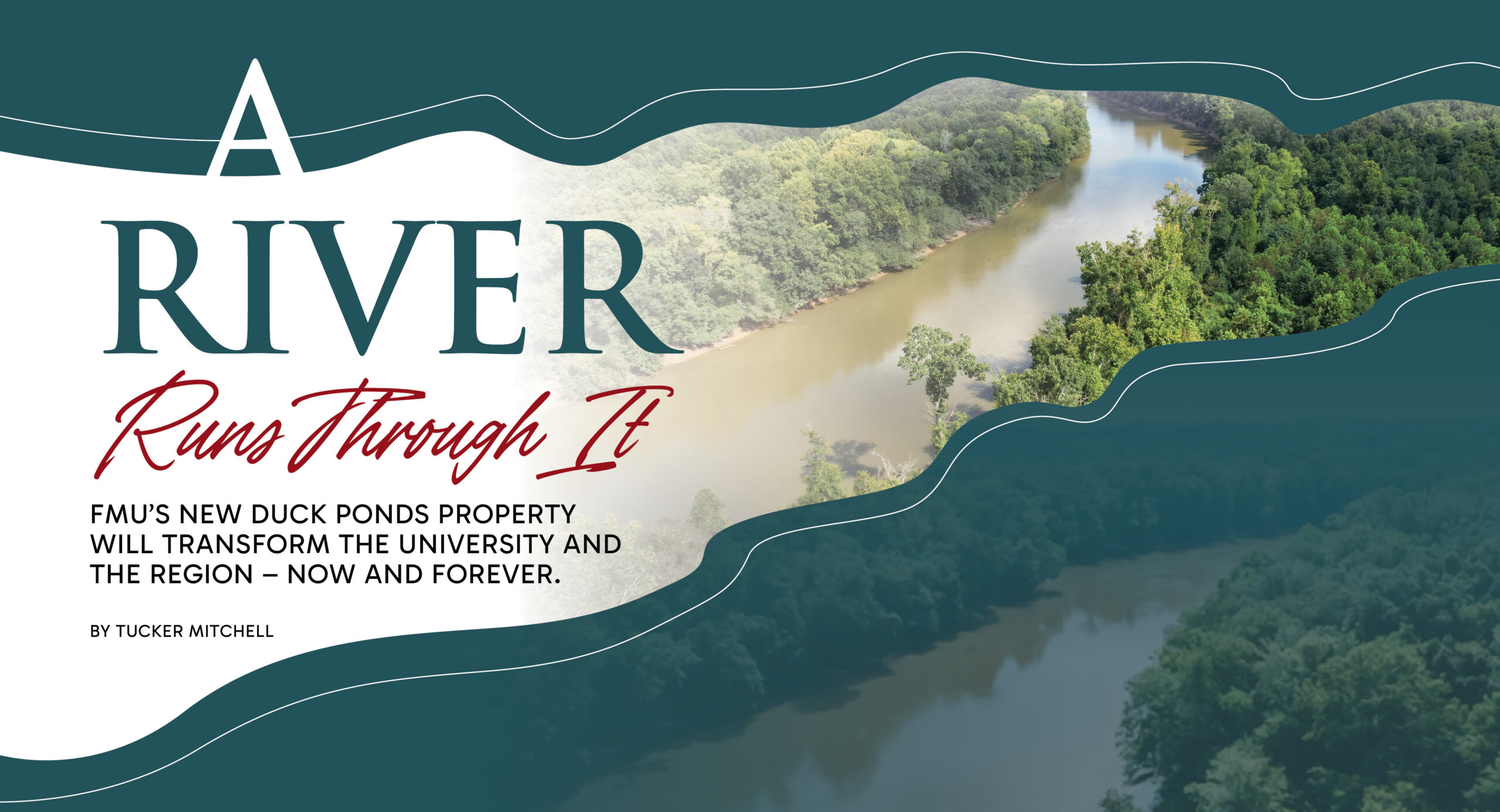
Following a decade-long campaign, and a complex transaction involving a half-dozen different entities, FMU is now the owner and operator of a new, 8,355-acre tract along the Great Pee Dee River, just east and north of the main campus.
The property, known as Duck Ponds because, yes, duck ponds are included in it, stretches roughly from the Highway 301 bridge north to the Wachovia Hills development. It courses along more than eight miles of Great Pee Dee riverfront and encompasses a portion of several tributary waterways as well.
Coupled with FMU’s previous land holdings, the university now has nearly 10,000 acres under its wing, and is the second-largest institutional landholder in the state. More importantly, it possesses a new tool that university leaders say will unlock unparalleled educational opportunities for decades to come.
“This acquisition is unprecedented and it’s difficult to grasp its scope and all it means,” says Dr. Fred Carter, FMU’s president. “It’s an incredible piece of land with vast potential. It’s going to take us a year or more just to kind of understand it. But that’s okay. It will be an unbelievable asset for many years to come.”
Says Dr. Jason Doll, the coordinator of FMU’s environmental studies program, “It’s great in so many important ways. … It’s difficult to wrap your head around something like this.”
A winding process
Duck Ponds is a wild and wet landscape filled with all kinds of interesting flora and fauna, and it has been that way for eons. Timber has been harvested from the site for a long time – the previous owners were timber-using corporations. A couple of hunting clubs have used parts of the property for more than a century.
FMU’s pursuit of the land doesn’t go back quite that far, but it’s a long-term proposition all the same. The university, and various governmental partners, have been looking at the tract, and others around it, with an eye towards acquisition and conservation for more than a decade. Preliminary conversations with the land’s corporate owners began then and started the ball rolling that led to the recent purchase.
The project finally came to fruition when an assortment of congruent interests – wildlife conservation, regional flood and storm abatement, heritage preservation, a massive educational laboratory – came together with willing landowners to create the opportunity for a major conservation acquisition. The Duck Ponds project is directly connected to a similar acquisition in 2024 of 7,600 acres in southern Florence County, at the confluence of the Great Pee Dee and Lynches rivers. FMU partnered with a variety of state agencies and non-profits on the initial project, known as the “Snow’s Island Assemblage,” too, because of its relative proximity to FMU and its connection to Snow’s Island, the famous, and somewhat legendary hideout of the university’s namesake, Revolutionary War Hero General Francis Marion.
The Snow’s Island Assemblage is held by the South Carolina Department of Natural Resources (SCDNR). FMU’s Carter says even though the university will not own the Snow’s Island property, it will still have ample access to the “Swamp Fox’s” old stomping grounds through a county park that is being constructed nearby.
The two projects form a critical conservation corridor along the Pee Dee that’s more than 15 miles long. The corridor actually connects two larger pieces of the Pee Dee flood plain – one north near Bennettsville, and one to the south of Johnsonville – and was identified as a high priority for conservation acquisition on the Southeastern Conservation Blueprint, a massive planning document that maps out long-term conservation needs across the southeastern United States.
The properties also ranked as the highest conservation priority for both the South Carolina Conservation Bank (SCCB) and the South Carolina Office of Resiliency (SCOR), organizations tasked with mapping out, and assisting in acquiring, conservable land that’s critical for the state’s future.
Raleigh West, director of the SCCB, says the Duck Ponds project “builds on recent conservation milestones, including Snow’s Island and the 62,000-acre S.C. Forestry Commission easement, and reflects strong momentum to continue protecting important lands throughout the region.”
Says FMU’s Carter, “we’re going to be part of something that’s very big, very impactful, across our region and well beyond. That feels good.”
Carter praised South Carolina Governor Henry McMaster’s interest in conservation and persistence in pushing agencies to bring the many working parts of the project together.
Besides FMU, the SCCB, SCOR, and the S.C. Department of Natural Resources, the Duck Ponds coalition also included Florence County, the non-profit Open Space Institute (OSI), and the Darla Moore Foundation. The Moore Foundation and OSI combined to fund the $22.5 million purchase until funds from the state and Florence County were available. Moore and OSI will be reimbursed. The state will eventually see some payback through a series of carbon sequestration grants and other federal conservation dollars.
Future ‘Development’
Duck Ponds is a sprawling, challenging piece of terrain that is currently all but inaccessible. Viable passage is by rough-hewn logging and hunting roads, and is not available at all for parts of the year when water levels are high.
FMU is working with Florence County and some of the legacy hunting groups to develop a plan for improving access. There will never be a major highway running through the property, but FMU is committed to opening it up for public access. The county’s funding of the project was, in part, based on the possibility of creating a unique new “eco-tourism” site. County officials are excited by that prospect, which would be unique in the state and nation.
While access will undoubtedly be improved, construction at the site will be just a few shed-like structures to store equipment and serve as a scientific staging ground, says Carter.
“The site is very limited,” says Carter. “Contrary to what some may think, there won’t be a lot there in terms of buildings.”
But there is a lot there.
Preserve and Educate
Faculty in FMU’s biology department, and especially in the newly formed departments of environmental science and forestry, are overwhelmed at the possibilities.
Dr. Andrew Londo, the recently hired head of the nascent forestry program, says that while it is common for major collegiate forestry programs to have a “lab forest,” it’s not common to have one like Duck Ponds.
“It’s nothing short of remarkable,” says Londo. “This kind of forest – bottomlands with all kinds of trees – is unique. It’s so big and so untouched from a research point of view, that it’s just hard to say what we’ll find out there. But there’s no doubt it will be a tremendous benefit, not just to forestry, but to environmental science, and a lot of other programs.”
Londo thinks the diversity of the tree population of the area will lead to all kinds of research, and the ability to work in a bottomland will be essential to forestry students planning to become the future managers of the region’s forests.
“It’s the kind of forest we have around here and it’s not like forests anywhere else,” says Londo. “Typically, this kind of land is owned by the (state or federal) forestry department, or by industry, and nobody much can go out there. That won’t be the case for our students.”
Dr. Doll, the environmental science program director, says the project is a boon from several perspectives.
“The first thing is just the land and water preservation,” says Doll. “There’s a few small tributaries – Black Creek is one – that runs through which serves as a valuable thermal refuge in summer. Having this land put into conservation assures us that the banks retain nurturing vegetation, overhanging trees and so on, so that (the waters) don’t get as hot. It assures there won’t be clear cutting, that there won’t be development. And that, that first thing, is important because there are several fish species that prefer cooler water. For a lot of them, it helps them survive. They go to those areas in summer.
“The next aspect is just the availability to take classes in ornithology, ichthyology, herpetology, all those fields, into a natural habitat for observation,” says Doll. “It saves us some time in not having to go far from campus, but more importantly, it puts us into this space that is not manipulated, not altered – not anthropogenically altered – and that is an extraordinary opportunity for students, faculty, and the community at large.”
And that, says Doll, is likely just the beginning. Benefits will accrue over time – long-term studies now become far more feasible – and develop in surprising ways.
“Those are just a few observations, a few ideas about what this means, what it could be, from looking at some aerial photographs,” says Doll. “We really don’t know what we have here.
“But,” he says, “we know it’s going to be great.”
The long run
Doll and others say one the most intriguing aspects of possible academic research in Duck Ponds is that ability to study trends over a long time. Research in an area like, for instance, nutrient flow in a flood plain, requires data to be acquired over decades before a true picture can be acquired.
Researchers can start projects one year, then watch as it is maintained by successive waves of students and faculty in the years – decades – to come.
“You can run some very long studies if you have the ability to control the land,” says Doll. “We’re looking forward to that. We’ll see what our faculty is interested in, what they can come up with.”
Carter enjoys the long view, too.
Land – and water – is an asset that lasts forever. Their importance and significance never go away. Indeed, for a unique site like Duck Ponds, it seems likely that the value will only grow as the waters flow and the years pass by.
“Man,” says Carter, “it’s the Great Pee Dee, one of the most breathtaking rivers in South Carolina. Revolutionary War and Civil War Battles were fought here. Francis Marion formed and dismissed his militia here. It’s an incredible place and it’s going to be something very special for this university and the community it has always supported.”
Best of all, Carter says, it will be here forever.
It’s called Duck Ponds, but the fish love it, too.
The Great Pee Dee River is home to a number of important fish species, including several that spawn in or near the waters now protected by Duck Ponds.
Dr. Jason Doll, associate professor of fisheries biology and director of FMU’s environmental science program, says several diadromus species (fish that migrate between salt and fresh water during their life cycles) are regulars in the river around Duck Ponds. Some spawn in the river. Some, like the Atlantic Sturgeon and the Short-Nose Sturgeon — both on the National Oceanic and Atmospheric (NOAA) endangered list — pass through Duck Ponds’ waters on the way to spawning grounds further upriver on the Great Pee Dee.
“They (the sturgeon) are heading upstream to spawn in shallow rocky areas of the river where the current is fairly fast,” says Doll. “They are only in the river when they spawn. The rest of the time, they are in the ocean or estuaries.”
There are a lot of other diadromous species that use the Great Pee Dee River, including fish such as Blueback Herring, American Shad, and Hickory Shad. Some catadromous species (fish that live in freshwater and migrate out to the ocean to spawn) such as the American Eel, can also be found in Duck Ponds’ waters.
Striped Bass, which are numerous in the area and well-known as a game fish, are potamodromous, meaning they migrate within freshwater systems for spawning.
LATEST FMU NEWS
LATEST INSTAGRAM
[instagram-feed feed=1]
GET SOCIAL