June 9, 2026
Fighting Fire with… Analysis
Fighting Fire with... Analysis
By Chris Day | Spring / Summer 2026 | FMU Focus Magazine Spring / Summer 2026
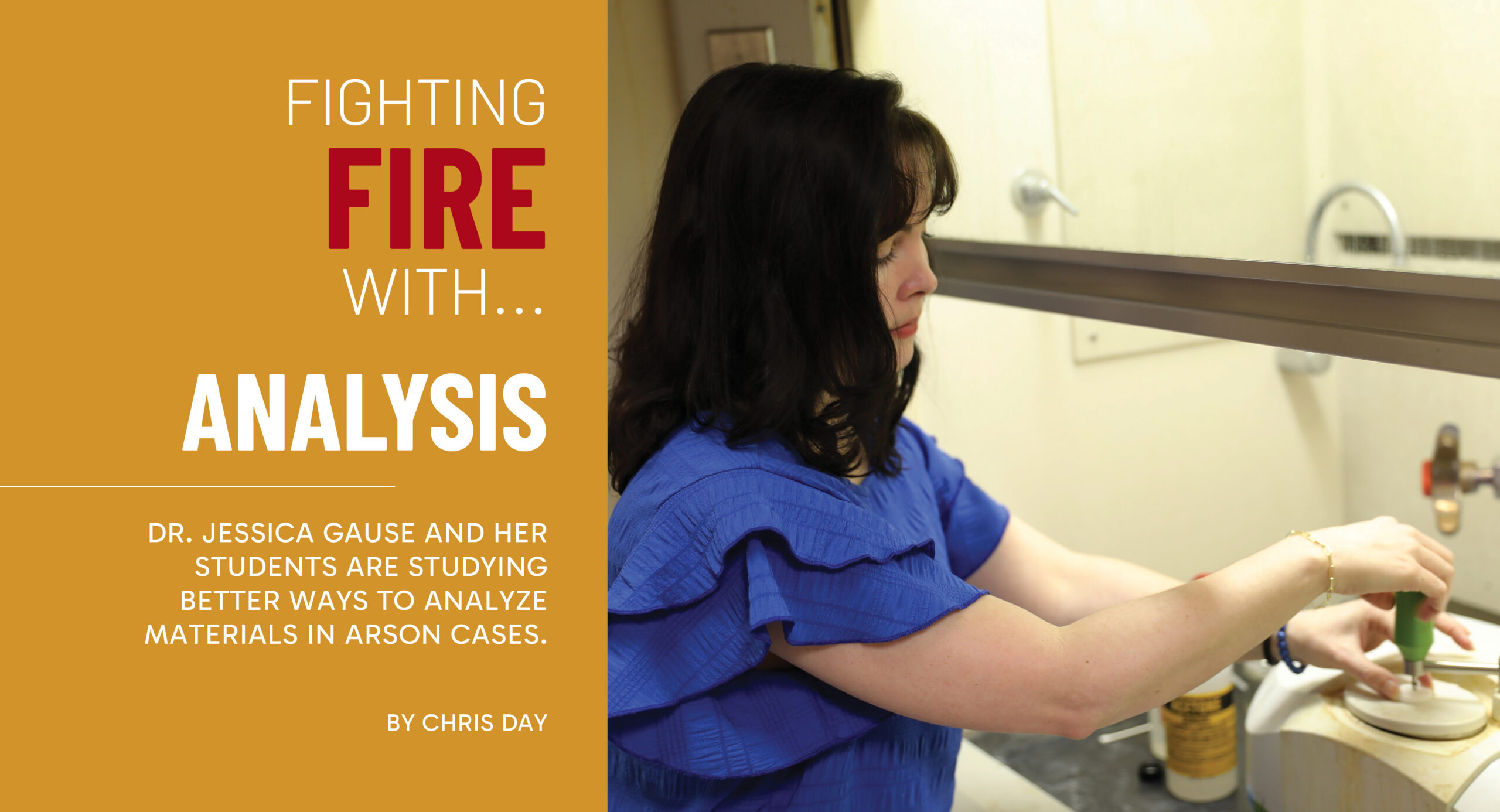
Francis Marion University Associate Professor of Chemistry Dr. Jessica McCutcheon Gause (‘06) and her students are working to make the identification of the accelerants used in arson cases easier and faster.
The goal: turn a process that currently takes two to four weeks into an instantaneous, at-the-scene operation.
To that, they’re working to develop a spectroscopy machine that’s small enough for fire investigators to take into the field. The device could “read” materials found on the scene, allowing investigators to almost immediately discover which accelerant was used in a particular arson case.
Gause says that early returns are promising.
“The data as of right now looks really good,” Gause says.
The current procedure for fire investigators now is to secure the scene, protect the area to prevent evidence contamination, and make observations about burn patterns and points of origin. After that, physical evidence, including samples of accelerants and other identifiable materials are collected. This step is crucial to establish if the fire was accidental or intentional.
The collected evidence is analyzed in a laboratory while the investigators examine burn patterns and review witness statements. If arson is suspected, all the information is compiled into a report, evidence is preserved and the firefighters ensure the investigation can withstand legal scrutiny.
The laboratory analysis can take two to four weeks, and currently, most analysis uses gas chromatography to analyze materials, a process that is not only slower, but which also destroys sample material as well.
Gause and her students are focusing on a form of spectroscopic analysis known as Fourier Transform Infrared Spectroscopy (FTIR), which applies infrared light to a material sample. It’s one of several types of infrared analysis.
With FTIR, the material sample absorbs the light, causing the sample’s molecules to vibrate. The vibrations are specific to specific types of molecules, and can be measured and turned in a standard spectroscopic analysis using a mathematical process known as the Fournier Transformation.
FTIR analysis is a broad spectrum type of spectroscopy and hence, can be used in a variety of fields. The arson investigation application that Gause and company are researching is being studied in labs around the world. Research needs to confirm the accuracy of the analysis in this area. Additionally, portable devices need to be invented for refinement.
Gause hopes to contribute to the pool of data on the subject. She knows she’s providing a challenging problem for her students, since the work involves both the actual lab experiments where the data is produced, and the computational (math) work required to transform the data into spectroscopic information typically used to confirm chemical analysis.
“Since I like statistics, we started looking into computational analysis of computer programs and researching different ones that did amazing things with the data,” says Gause. “So, I did a little bit of the computational as well as the actual research in the lab with the experiments.”
The students, she says, like both the analysis of computer programs and spectroscopy.
“They see the need for both,” says Gause. “I try to give them a little bit of each, but they get the real-world applications. Then, we go in the lab, do the data, see it on the computer and how it can be used to determine the results or optimize the results.”
For now, the research continues, but someday Gause hopes to see it used in the field to detect arson accelerants on scene.
Gause has researched subjects related to forensics ever since she arrived at FMU, including blood stain analysis. She teaches general chemistry, analytical chemistry, instrumental chemistry, and forensics.
“Forensics is new,” says Gause. “It’s a class that I developed and started as an honors class. Now, we have a degree option in chemistry in forensics,” Gause says.
Gause says her first group of students to graduate with the forensic option will graduate next fall.
“That’s very exciting,” Gause says.
LATEST FMU NEWS
LATEST INSTAGRAM
[instagram-feed feed=1]
GET SOCIAL