SOCIOLOGY MAJOR
General Track
Students with a broad interest in understanding society and current issues faced by members of society, such as racial/ethnic disparities, gender inequality, or the impact of disasters, should follow the general track within Sociology. This track prepares students for jobs in a variety of fields, including social services, community work, business, teaching, and research. Sociology graduates have gone on to become social workers, counselors, teachers, and emergency preparedness directors. Students within this track have also pursued graduate-level degrees to expand their career opportunities.
A major in Sociology requires the following:
Six Core courses:
201 – Introduction to Sociology
302 – Social Research Methods
303 – Social Statistics and Data Analysis
339 – Sociological Theory
403 – Survey Methodology
496 – Sociology Capstone Experience
Five courses in General Sociology selected from:
306 – Social Problems
310 – Race and Society
311 – Economic Inequality
315 – Gender and Society
327 – Aging and Later Life
331 – Environment and Society
333 – Urban Sociology
334 – Population and Society
361 – Self and Identity in Society
374 – Work in Society
375 – Society, Health, and Medicine
376 – Social Perspectives on Mental Health and Illness
381 – Sports in Society: Problems and Potentials
382 – Modern Families
384 – Education in Society
387 – Death and Dying
388 – Disasters and Extreme Events
389 – Religious Life
One course in Crime and Deviance selected from:
341 – Criminology
342 – Social Deviance
343 – Juvenile Delinquency
344 – Violence in Society
346 – Crime and Organizations
347 – Alcohol, Drugs and Society
348 – Family Violence
349 – Hate Crimes and Terrorism
351 – Environmental Crime
352 – Rural Crime
353 – Human Trafficking
One additional sociology elective course above the 299 level
498 – Sociology Internship is a recommended, but optional, elective.
The Department also offers Sociology 205, Interpersonal Relationships and Family Life, as a “no prerequisite” elective course.
Minor or Collateral in Sociology
A minor requires 18 hours, including Sociology 201.
A collateral requires 12 hours, including Sociology 201.
No more than six hours in either the minor or collateral can be earned from courses below the 300 level.
SOCIOLOGY MAJOR
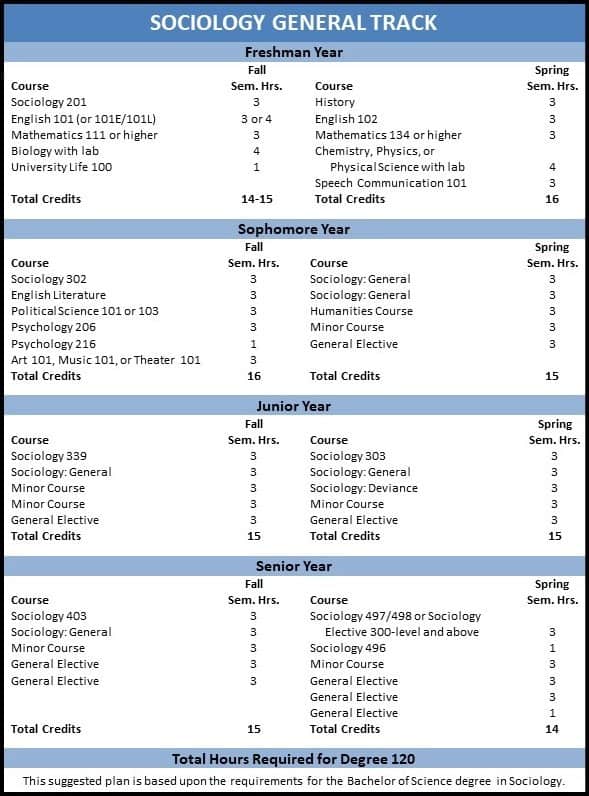
Recommended Four-Year Plan for General Track